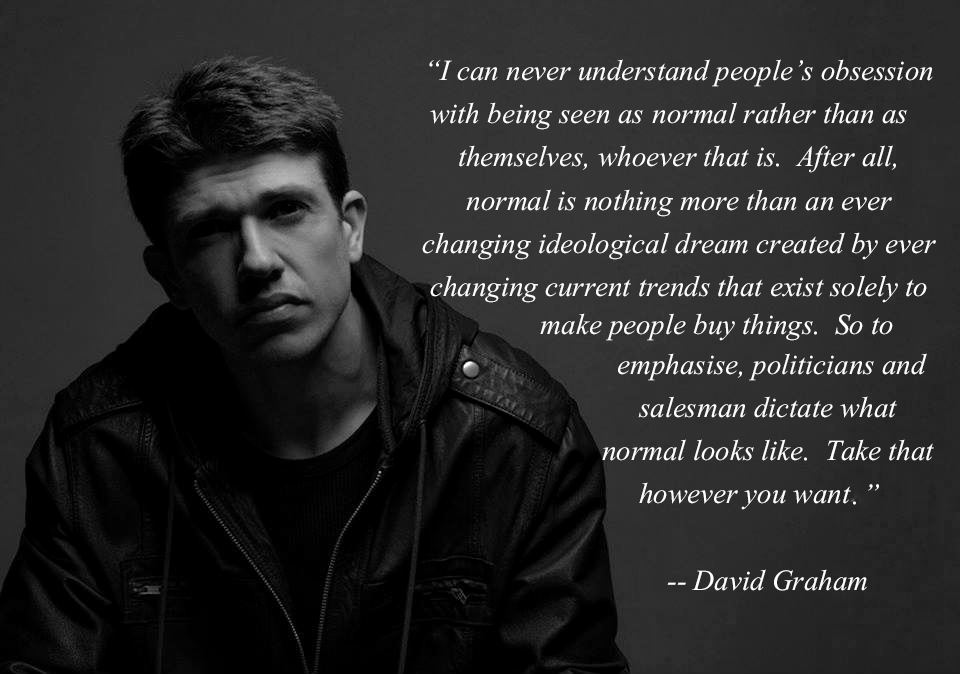
The majority of people want to be normal, but what even is normal? Nobody really knows, or do they? The answer is complex, and to try to bring some light to it, I decided to write this post, so let’s get to it.
What does normal mean?
The dictionary definition of normal is, when used in adjective form, the usual, typical, or expected state or condition, and when used in noun form, conforming to a standard; usual, typical, or expected.
But this does not tell us at all what normal means in the sense people normally ask it. That’s because normal is the law of averages.
For example, if out of a hundred people, ninety had a normal body temperature of 37°C, the normal body temperature would be 37°C. But this is where things get complex, just because that is the normal temperature for this group, does not mean that the ten people who have a different body temperature have abnormal body temperatures; it is just that their body temperatures are different from those of the majority.
This is why defining normal is such a difficult thing to do. You have to work out what normal you are looking to define. The group’s normal, an individual’s normal, a segment of the group’s normal. On the list goes.
This is why, to define what is normal, you first have to define how you wish to define normal. For example, if you wish to define what is normal for you, using body temperature again, you would test your temperature over the course of a month or so and log the results, and your normal temperature would be the average of those results.
But if you wanted to define what the normal body temperature for all the human race is, you would need to know the normal body temperatures of a large number of people, and the normal body temperature would be the average of all those combined.
That means normal means whatever you want it to mean because you get to choose the context and the dataset that you use to define it; hence, why it’s so complex to talk about normal.
What is a normal person?
Technically, there is no such thing as a normal person. This is because the only way to define a normal person is using the law of averages, but just because seventy people turn left at the end of a junction and thirty people turn right does not mean that the thirty people who turn right are doing something abnormal.
You could even argue that the people turning right are just as normal as the people turning left, mainly because all would undoubtedly be choosing the direction that they think is best to travel in, and it is normal to want to travel in the direction you think it is best.
So, a normal person is whatever a person wants it to be, mainly because, as said earlier, they get to choose the dataset by which they define what is normal. But if I were to take a guess at what a normal person is, it’s a person who wants to survive and be happy, and wants to do all the things that they think will best help them in those endeavours, whatever they are.
What is normal behaviour?
Normal behaviour is once again defined by the law of averages. For example, it is normal to want to be normal because the majority want to be normal, and the majority want to be normal because by copying the most successful behaviours, it gives them the best survival chances.
So again, like in the previous point, the most normal behaviour is to desire to survive and be happy, and to do whatever you feel is best towards those endeavours. Most choose to copy the majority because that is the most tried and tested survival behaviour, but not all.
What is unusual?
This is a tough one, because again, context is everything. But once more it comes down to the law of averages.
For example, if every time a person goes to their favourite bar, they ask for a Foster’s beer, when they ask the bartender for the usual, the bartender will know to give that person a Foster’s beer. But should they ask for a different drink, they would not be doing something unusual, they would just be doing something different.
But it may be seen as unusual for them. This is not like you.
Something even more unusual would be, should this person ask for their usual, the bartender gives them something different.
So when talking about something that is usually unusual, it really comes down to the law of averages in context. Something that is unusual is something that goes against the law of averages, but that does not mean that it’s odd. Context is everything.
What does it mean to be normal?
The most common definition people give when asked this question is that what it means to be normal is to comply with what is expected by others. But that’s only because the majority of people think that, but those who think it means something else are not wrong, they just think differently from what the majority think.
So again, what it means to be normal is whatever you want it to me. The choice really is your own.
What is considered normal?
This question cannot be answered without context. For example, a person may ask what is considered a normal grade in mathematics, or they may ask what is considered a normal sunset. But they cannot just ask what is considered normal namely because without context the question is asking nothing, or rather in a way it is like asking a question along the lines of what is the colour, but then not specifying what it is they want to know the colour of.
But mostly when people ask what is considered normal, they are asking what does the atypical person look like, behave like, and more importantly, what is expected from them.
For example, most people are expected to get at least a grade C at school; they are also expected to be law-abiding and to work in a typical 9-to-5 job. But again, none of that makes a person who does none of those things odd. It just makes them not part of the majority, which a large number of people are not.
For example, if a person consistently gets a grade C, then what is considered normal for that person is a grade C, which would make them an atypical student. But if another consistently gets an A, then what is considered normal for them is to get an A, but that would make them not normal – at least by the standards of the atypical student.
That means what is considered normal is dependent on the perspective from which you are looking at it. From the group level, there will be a lot of non-atypical people; from the individual level, everybody in their own way is normal.
What is normal in society?
To answer this, you first have to answer which society. For example, a person may wish to know what is normal for the nation in which they live, or they may wish to know what is normal for a different nation, and what is normal will be different.
But not just in another nation. For example, they may wish to know what is normal for their region, or for their city, or they may wish to know what is normal for the global science fiction community, or for the local science fiction community.
The answer in every case is however the majority of the selected group behave, but just because they behave that way, does not make it normal for another society.
So what is normal in a society is defined by how the majority in that society think and behave.
Why do I want to be normal?
The simple answer is that being normal is seen as the path to being accepted. For example, the majority of people do not want to be alone, which means it is normal to not want to be alone, and a person who is unable to connect with others usually ends up feeling alone.
So, you could argue that the reason you want to be normal is that you want to connect with people, and the only way to connect with people is to have a similar way of thinking to them.
So, people don’t want to be normal per se, and nor likely do you, they want to be around people who think like them, as you likely do. It’s just the most tried and tested way to find people to connect with is to embrace the thinking and behaviour of the majority, because that increases your options.
But if you don’t think like that, and don’t want to behave like that, then you shouldn’t. You should find a world where the way you think and behave is the normal behaviour. It exists, you just have to find.
If I am not normal, will people reject me?
The only way to find out is to show yourself to the world and see how it responds.
If you have already done this, and people have rejected you for being who you are then there are two possibilities: one, there is a problem with you, namely in regards to how you treat other people and you need to address it otherwise people will continue to reject you; two, you have been approaching the wrong people.
If it’s the former, you need to work on yourself to be accepted. If it’s the latter, you don’t need to change who you are to be accepted by others because you are normal under the context of you as an individual, what you need to do is change the people in your life.
To put it more bluntly, you need to replace the people you don’t connect with with people you do connect with. When you do that, you’ll be surrounded by people who consider you to be normal, because you’ll be surrounded by people who have the same normal as you do.
So you don’t need to be normal to be accepted by others, you just need to find others who have the same normal as you do. Which, paradoxically, means if you are not normal, people will probably on some wavelength reject you. But not because you are odd, but because you are not right for them and they are not right for you.
 The Knowledge of Freedom